1. Zucchini belongs to vegetables that consume a lot of nutrients, so humus-rich sand and crumbly loam soils, as well as humus-enriched peaty soils are the most suitable;
2. Loose, fertile, quick-warming sandy loam and loam soils are the most suitable for zucchini.
Soil preparation
1. Zucchini should be grown in the soil at 3-year intervals, but preferably at 5-year intervals;
2. The best pre-plants are fallow crops (cabbage, potatoes, beets, carrots), as well as onions, legumes;
3. Zucchinis are good precursors for other vegetable crops;
4. It is not recommended to grow zucchinis after other pumpkins;
5. Although zucchinis have a relatively shallow root system (15-25 cm), they need deeply cultivated soil, which can be prepared already in autumn - by plowing the soil and incorporating manure or decomposed compost (up to 15 kg/m2);
6. The optimal level of soil acidity for zucchini is pH(KCl) 6.0 – 6.4;
7. Organic manure can be incorporated directly into planting sites, which will contribute to faster soil warming, or incorporated into rows or beds;
8. When incorporating manure, it should be taken into account that the soil will be "enriched" with weed seeds and weed control should be planned in time (for example, by mulching the beds with film or agronet);
9. According to the legislation in force, the amount of N given with the total amount of applied manure may not exceed 170 kg N/ha;
10. Sowing distance for zucchini in rows 0.6 – 1.2 m x 0.6 – 0.7 m (12,000 – 15,000 pieces/ha) plant by plant. When sowing seeds directly in the field, a larger quantity of sown seeds will be required;
11. Until now, no herbicide has been registered in Latvia for controlling weeds in pumpkin plantations, therefore the only options are mulching and/or weeding the plantations by hand;
12. When limiting weeds, be careful not to injure the pumpkin roots;
13. If the weeds are large, it is better to cut them rather than pull them out;
14. A relatively good way of controlling weeds in zucchini crops and plantings is black film or agronet mulch, which is spread before planting;
15. Zucchini, growing rapidly and forming large leaves, later quite successfully shade the soil themselves, and thus also the weeds.
Climatic conditions and humidity
1. Fields where zucchini will be grown should preferably be protected from the wind at the beginning of the growing period in order to maintain a better heat and moisture regime;
2. At the end of the season, moderate wind reduces the spread of diseases;
3. Sunny south, south-east and south-west slopes are best;
4. Zucchini growing areas should be additionally provided with water for watering and fertilizing during the vegetation period;
5. Zucchini can be sown directly in the field or seedlings can be grown in advance, thus obtaining a harvest 7-10 days earlier;
6. Seed germination begins when the soil temperature exceeds +15 C, but the optimal temperature for rapid germination is +22 – 25 C;
7. Seeds are sown in the field in the last days of May, 3-4 cm deep.
8. Seedling cultivation begins for zucchini about 15-20 days before planting (the earlier the planting, the longer the seedling cultivation period);
9. Seedlings are put out in the field when the spring frosts are over, in early June;
10. A good seedling should be strong, with a sufficient root system and at least 1-3 true leaves;
11. The optimal growing temperature in the field is +18 – 25 C, the optimal number of plants for zucchini is 1.2 – 1.4 plants per 1 m2;
12. When planting zucchini seedlings early (at the end of April, beginning of May), it is recommended to use an agronet cover to protect against frost;
13. The main care works are watering, if necessary, weed control, additional fertilizing, limiting diseases and pests. Zucchini are sensitive to temporary lack of moisture.
Plant and soil fertilization recommendations and conditions
1. The fertilization plan is drawn up taking into account soil analysis data, the requirements of the cultivated crop and variety, and the planned harvest;
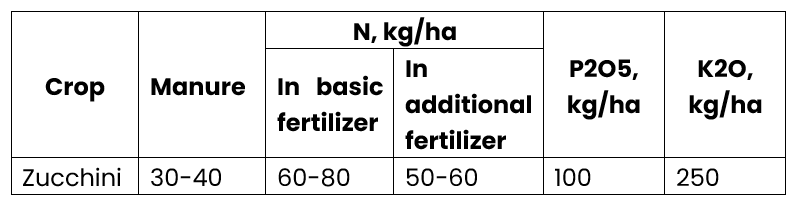
2. In an open field, 30-40 t/ha of manure is given to zucchini;
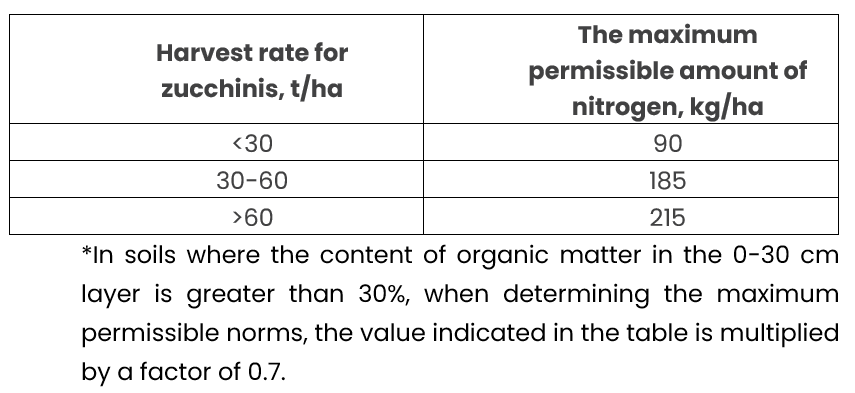
3. The maximum permissible amount of nitrogen* that can be applied to crops in one harvest period, depending on the planned yield level:
4. Mineral fertilizers can be incorporated separately - in autumn and spring - incorporation of mineral fertilizers into basic fertilization before sowing or at the same time as sowing; 5. Mineral fertilizers containing chlorine, to which zucchini are sensitive, are not recommended; 6. It should be noted that slurry also contains a small amount of sodium chloride. Zucchini are more sensitive to the application of fresh manure in spring, especially in dry weather, - leaf burns may occur due to released ammonia; 7. When giving complex fertilizer in spring, the NPK ratio should be 1: 1.5; 8. At the beginning of cultivation, plants need more nitrogen (N) fertilizer, calcium (Ca), but during flowering and fruit formation, the dose of phosphorus (F) and potassium (K) fertilizer should be increased; 9. Zucchini are more demanding of nitrogen throughout the season; 10. In light, sandy soils, the magnesium (Mg) content in the soil should be monitored; 11. Approximate fertilizer rates:
12. Applying a fertilizer containing calcium cyanamide (Perlka) 10-14 days before sowing or planting seedlings simultaneously limits the number of pests, pathogens and germinating weeds in the top 8-10 cm of the soil.
 عربي
 English
 हिंदी
 Español
 繁體中文
 Français
 Português
 日本