


Corn fertilization

When choosing varieties/hybrids, the agro-climatic conditions of the specific region must first be taken into account, as well as the dry matter content indicated in the characteristics of the variety/hybrid and test results, the purpose for which the corn will be grown, the resistance of the variety/hybrid to diseases, the risks of growing on the farm and also in the specific field must be evaluated, the farms must be evaluated opportunities to provide potentially high-yielding varieties/hybrids with appropriate growing conditions, appropriate fertilizers and plant protection products.
Soil

  1. 1. Well-cultivated, rich in high organic matter content, light sandy loam and loamy soil, which warms up faster in spring and whose pHKCl is in the range of 5.8 - 7.3 with sufficient moisture provision;
  2. 2. It can also be grown in light sand and peat soils, but in this case the soil must be fertile;3. Heavy, compacted clay soils are not really suitable for growing corn.

Soil preparation

  1. 1. Many scientific studies/articles indicate that corn can be grown as a monoculture, however there are also indications that corn should not be grown in one field for more than 3 years;
  2. 2. This is related to the possible appearance of a dangerous pest - the corn beetle (Diabrotica virgifera virgifera) in Latvia. Since the larvae of this pest damage the roots of corn plants, the use of insecticides by spraying is not effective;
  3. 3. Changing plants is one of the most effective means of controlling this pest;
  4. 4. Currently, corn is a crop that is little affected by diseases and pests, which can be explained by the fact that corn is not grown in large areas in Latvia;
  5. 5. The most suitable precursors for corn are cereals (wheat, triticale and barley), legumes, clover and alfalfa;
  6. 6. It is not recommended to grow corn in long-term, unkempt perennial grass or overgrown fields, as the caterpillars of the caterpillars usually multiply there.
  7. 7. In general, tillage for maize is not much different from tillage for cover crops, but it can also be grown with minimal tillage;
  8. 8. If corn is grown in a monoculture, in order not to promote the multiplication of harmful organisms, it is better to perform traditional tillage;
  9. 9. If corn is grown after cereals, the straw is chopped and spread on the field, additionally nitrogen fertilizer ~ 10 kg N /1 t of straw is used so that it decomposes faster;
  10. 10. After harvesting the pre-plant, the soil can be disked and after about 2 weeks plowing, cultivation, milling or the field can be treated with preparations containing glyphosate, if necessary;
  11. 11. After using the herbicide, after the exposure time specified in the label text, making sure that the plants and their roots have died, the field is plowed to a depth of 20 - 25 cm, then the field is cultivated, milled, harrowed, processed depending on the equipment used on the farm;
  12. 12. Deep tillage is necessary so that corn roots can develop better and absorb water and nutrients during the period of active growth;
  13. 13. Plowing, deep-rooting and cultivation of the soil create more favorable conditions for the activity of soil microorganisms, plant residues decompose faster, and thus the chances of the multiplication of diseases and pests also decrease;
  14. 14. In order to ensure uniform and rapid germination of corn, the seed bed should be dense, and the upper layer should be fine-grained, but not dusty.

Soil and plant fertilization conditions

  1. 1. Maize fertilization must be carried out in agronomically appropriate terms, according to the norms provided for in the fertilization plan;
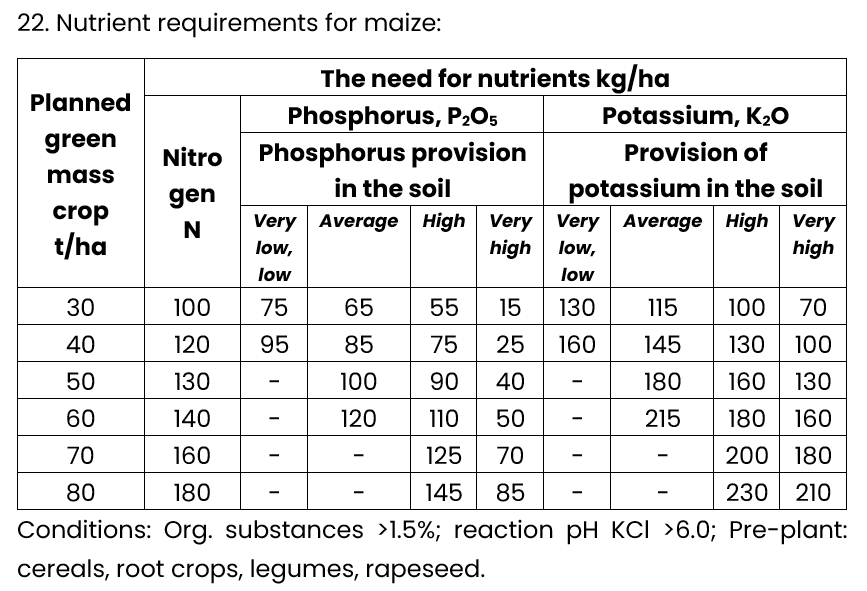
  2. 2. When calculating the need for fertilizer, the provision of nutrients in the soil found in the results of soil analysis, as well as the nitrogen required for the decomposition process of the incorporated pre-plant residues, the planned yield of corn should be taken into account;
  3. 3. Manure, composts, digestate produced in biogas cogeneration stations, green manure supplemented with mineral fertilizers can be used to increase soil fertility;
  4. 4. According to the legislation in force, the amount of N given with the total amount of applied manure may not exceed 170 kg N/ha;
  5. 5. During the period of active growth, in order to make better use of both the nutrients in the soil and the applied supplementary fertiliser, especially nitrogen fertiliser, both heat and moisture are needed, so in the colder period, when the growth of maize is delayed, nitrogen supplementary fertilizer should be used when the maize has resumed intensive growth;
  6. 6. For corn, all the necessary phosphorus and potassium norms and a third of the nitrogen fertilizer are usually incorporated into the basic fertilizer;
  7. 7. Phosphorus fertilizer promotes germination, stronger development of the root system;
  8. 8. If corn is planned to be grown for grain production, then it is phosphorus that contributes to the departure and ripening of the grain;
  9. 9. If plants lack phosphorus, corn leaves acquire a reddish tint along the edges of the leaves or a blue-violet tint on the older leaves;
  10. 10. Potassium contributes to the increase in the volume and quality of the harvest, the resistance of the veld, the water absorption capacity of plants;
  11. 11. As a result of the lack of potassium, the oldest leaves of corn become pale, the plants look like they are frozen;
  12. 12. When planning corn fertilization, attention should also be paid to the supply of magnesium, calcium and zinc to plants;
  13. 13. Magnesium is a part of chlorophyll, without magnesium photosynthesis does not take place, but as a result of zinc deficiency, larger spots appear on corn leaves on both sides of the main vein, spots also appear at the base of the leaves;
  14. 14. If the soils are acidic, the pHKCl is less than 5.5, then the soils must be limed;
  15. 15. Calcium in corn plants improves the absorption of other nutrients;
  16. 16. Additional fertilization with nitrogen fertilizer is carried out for the first time in the spring, when the corn has developed 5 - 6 leaves, the second time, depending on weather conditions, after 2 - 3 weeks;
  17. 17. When applying additional fertilization, make sure that the leaves of the plants are dry;
  18. 18. In order not to burn the leaves, it is possible to add special devices to the mineral fertilizer spreaders, which lead the mineral fertilizers into the plant rows; It must be ensured that the nitrogen fertilizer does not stick to the corn leaves or remain in the leaf sheaths;
  19. 19. Liquid manure and digestate can be used as top dressing in corn crops;
  20. 20. Cu, Mn, B are also needed to ensure the appropriate quality of the obtained harvest;
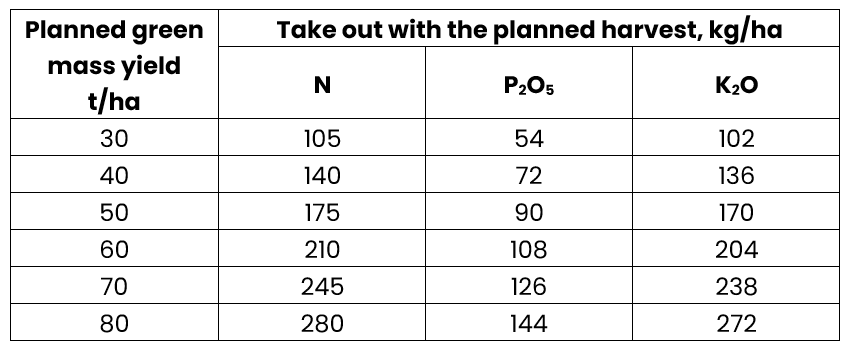
  21. 21. Nutrients are removed with the corn crop:
  • 23. Yield without fertilizer:
    • a. In poorly cultivated soil 15 t/ha
    • b. In well cultivated soil 30 t/ha.
      • i. Notes: the recommended fertilizer rates are given assuming that organic fertilizers with a long-lasting aftereffect, e.g. straw, are also periodically used in the given field.
      • ii. In peat moss, the need for N fertilizer is reduced by 1/3.
    • c. Nitrogen (part), phosphorus and potassium mineral fertilizers are incorporated into basic fertilization in the spring - before sowing or at the same time.
    • d. Nitrogen is given separately:
      • i. About 30 kg/ha of N in basic fertilizer;
      • ii. In additional fertilization after the appearance of 5-6 leaves;
      • iii. In additional fertilization after the appearance of 8-10 leaves;
      • iiii. Part of the necessary nutrients should preferably be provided with organic fertilizers.
If You have any questions
please contact us!
Contact Us