1. Wide and flat (with a slope of up to 7 degrees) drained fields without stones are suitable for growing potatoes, so that they do not suffer from excessive moisture;
2. Loose soil with good air capacity, sufficient nutrient content and moisture provision is suitable for growing potatoes;
3. Potatoes can be grown in lighter mineral soils, but the most suitable are well-cultivated, humus-rich, loose and quick-warming loamy and loamy soils;
4. Potatoes can also be successfully grown in cultivated lighter sand soils;
5. Heavy clay soils are not suitable for growing potatoes. The optimal soil acidity is pHKCl 5.0-6.0, but more acidic soils will also be suitable.
Soil preparation
1. The most suitable potato pre-plants and post-plants are those crops for which similar soil properties are optimal for growing;
2. Post-plants rationally use the positive influence of the pre-plant on soil fertility, they are little or not harmed by weeds, diseases and pests left in the field;
3. Potatoes can be grown after different precursors. The best pre-plant is rye;
4. Good precursors are also clover, legumes, cereals and buckwheat;
5. Permissible precursors are corn and flax;
6. Can be grown after cruciferous vegetables - mustard, oil radish and rapeseed. Thus, the spread of soil pathogenic diseases is limited, but it should be taken into account that it may affect the taste characteristics of potatoes;
7. If potatoes are grown after perennial grasses, there is a possible higher risk of damage by crackers and mayfly larvae;
8. The herbicides used in the field in previous years should be evaluated in order not to expose the potatoes to the risk of their after-effects;
9. The herbicides used in the potato plantation may have an after-effect on the next cultivated crop or post-plant;
10. Potatoes are grown in one field for no more than three years in a row without changing plants;
11. If potatoes are replanted in the same field, the same variety as the previous year must be chosen to avoid a mixture of varieties;
12. However, it is recommended to grow potatoes in the same field every three years;
13. Potatoes require a much looser soil than other crops;
14. Potatoes are less sensitive to plowing the deeper subsoil layer;
15. For potatoes, the soil must be plowed to a depth of 25-27 cm already in the autumn of the previous year;
16. To reduce soil compaction, combined aggregates should be used as much as possible in soil treatment (Gaujers, 1980; Narvils, 2000; Kreita, 2001);
17. For high-quality soil preparation, it is recommended to use aggregates that break up the soil, including the arum sole (vertical tiller, deep tiller);
18. It is necessary to avoid processing overmoistened (non-crumbling) soil;
19. It is possible to prepare the soil sufficiently loose also with a cultivator;
20. A well-prepared soil is loose in the depth of the whole crop and without large corns;
21. It is not recommended to plant potatoes in freshly limed soil. If it is necessary to lime, it is done for the pre-plant.
Climatic conditions and humidity
1. During germination, the potato uses the nutrients and moisture stored in the seed or mother tuber to form sprouts and roots;
2. During this time, the plant does not need to absorb moisture and nutrients from the soil, it is important to provide air in the soil.
Plant and soil fertilization recommendations and conditions
1. During the formation of shoots, until the time of flowering, the plant takes in 25% of the necessary nutrients. During this time, the plant also needs moisture for the formation of leaves and shoots;
2. After flowering, during the formation of new tubers, potatoes absorb half of the necessary nutrients;
3. The remaining quarter of the required fertilizer is absorbed by the plant during the ripening and ripening of the new tuber;
4. It is preferable to use a chlorine-free complex fertilizer, which also contains trace elements;
5. The complex fertilizer provides the spectrum of the main nutrients, including trace elements;
6. If necessary, additionally provides the missing nutrients;
7. It is recommended to give nitrogen fertilizer divided: a part - at the time of planting in a complex fertilizer composition and the rest - as a top dressing until flowering;
8. In stressful conditions (drought, heat, cold) or in case of a micronutrient deficiency, it is recommended to use foliar (external root) fertilizer;
9. To grow a quality potato crop:a. soil analyzes should be carried out to determine the content of phosphorus, potassium and organic matter and soil pHKCl;b. in addition, it is desirable to determine the content of magnesium, calcium, also microelements;c. the required amount of nitrogen is calculated depending on the type of use of the crop.
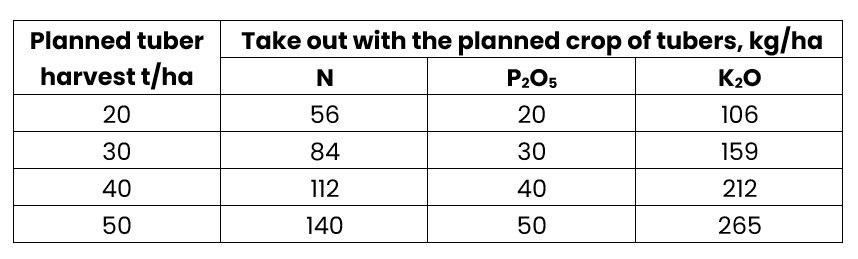
10. The need for nutrients can be judged by the removal of plant nutrients with the crop. It varies depending on meteorological conditions, soil properties, fertilizer doses and their ratios, varieties' characteristics, etc.;
11. Nutrients are removed with the potato crop:
12. With 100 kg of harvest (main production together with the corresponding by-product – potato pods), potato plants also produce 0.19 kg of Ca, 0.08 kg of Mg and 0.02 kg of S;
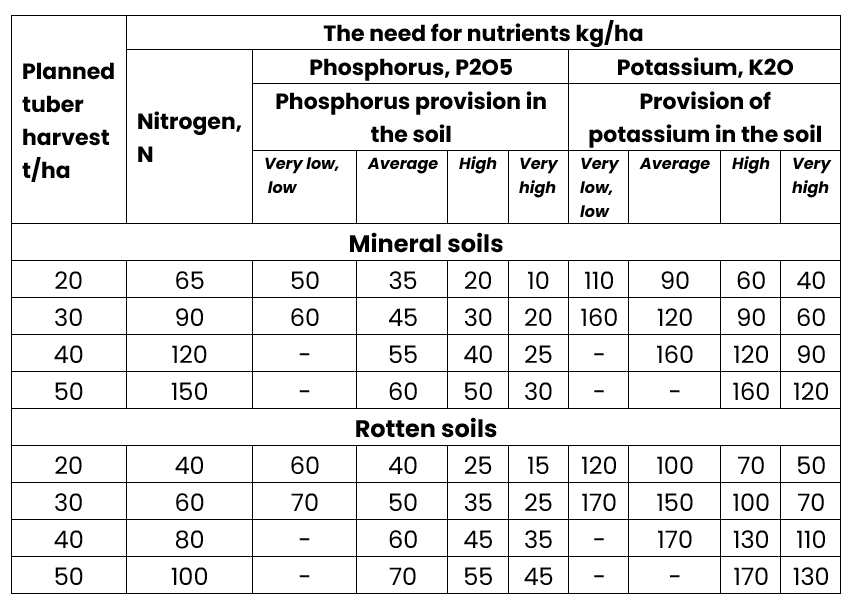
13. The need for fertilizer is determined by the size of the planned harvest, the purpose of use, the stock of nutrients in the soil and their usability;
14. The need for nutrients for potatoes:
Conditions: Org. substances >1.8%; reaction pH KCl >5.5; Pre-plant: cereals, legumes, green mass plants, high-yielding perennial grasses, rapeseed.
15. Yield without fertilizer:
16. In poorly cultivated soil, 10 t/ha
17. In well cultivated soil 20 t/ha:a. Notes: the recommended fertilizer rates are given assuming that organic fertilizers with a long-lasting effect, e.g. straw, are also periodically used in the given field.
18. In mineral soils, it is preferable to provide part of the nutrients needed for potatoes with organic fertilizers;
19. For seed potatoes, it is not recommended to use a nitrogen rate higher than 90 kg/ha;
20. For potatoes, moderately high rates of nitrogen and potassium are used for starch extraction;
21. It is preferable to use chlorine-free fertilizers;
22. Characteristics of feed elements:
a. Main nutrients:
i. Nitrogen (N) directly affects potato growth, development and productivity. If potatoes receive less nitrogen, smaller tubers are formed (this is desirable for seeding), they are also less injured, better stored and have a higher starch content. If there is more nitrogen, the proportion of large tubers increases. When feeding, plants mainly use ammonium and nitrate compounds. Nitrogen deficiency occurs in compacted soils after periods of rain, in dry weather, as well as in light soils due to leaching of nitrogen. Excessive amounts of nitrogen cause the growth of weeds, delay the maturation of tubers, promote the spread of diseases, as well as worsen the taste characteristics of the tubers and contribute to the darkening of the pulp of the tubers after peeling and cooking;
ii. Phosphorus (P) is needed by potatoes for protein synthesis, as well as for growth and reproduction processes. Phosphorus accelerates the growth and development of plants, promotes the development of the root system, the formation of tubers, the accumulation of starch, improves the taste characteristics, increases the number of tubers, promotes the faster progress of all phases of development, including the maturation of tubers, and also increases the yield in phosphorus-poor soils. The tubers are less susceptible to injury and darkening is reduced. Phosphorus is most difficult to use in acidic soils rich in aluminum and iron compounds or in calcium and magnesium;
iii. Potassium (K) promotes photosynthesis, movement of carbohydrates from leaves to tubers, improves water use efficiency, promotes starch accumulation, increasing potato resistance to drought and frost, diseases, mechanical damage, and reduces darkening. More vitamin C is formed in the tubers and the taste characteristics improve. Among plant nutrients, potatoes consume the most potassium compounds. Potassium deficiency is observed in peaty and floodplain soils.
b. Secondary nutrients:
i. Magnesium (Mg) is important for efficient photosynthesis, its deficiency is caused by a large amount of potassium and the missing balance between potassium and magnesium. The availability of magnesium is reduced in acidic soils;
ii. Calcium (Ca) compounds are important for cell function and root formation. Calcium availability is reduced in acidic soils;
iii. Sulfur (S) is an important component of proteins. Low sulfur is most often found in light soils;
c. Micronutrients - The need for micronutrients depends on the amount of easily absorbed micronutrients in the soil. If the field is fertilized with manure or compost, there is almost no need for micronutrient fertilization. There is no point in giving micronutrient fertilizers if the required N : P2O5 : K2O ratio is not provided. Productivity is determined by the least provided element;
d. Boron (B) is considered a scab and crack reducing element;
e. Manganese (Mn) also reduces the formation of scabs and cracks;
f. Iron (Fe) compounds act as enzyme activators, are involved in photosynthesis and synthesizing important proteins for plants.
23. Along with the aforementioned nutrients, potatoes need copper (Cu), zinc (Zn), molybdenum (Mo) and cobalt (Co) compounds usable in the soil;
24. Organic fertilizer - Depending on the amount of nutrients in the manure, 25-30 tons of composted manure is applied per hectare, which is given to the pre-plant. According to the regulations of the Cabinet of Ministers of December 23, 2014 no. 834 "Rules on the protection of water and soil from pollution with nitrates caused by agricultural activity" the amount of N given with the total amount of applied manure must not exceed 170 kg N/ha. The soil can be enriched with green manure, vermicompost, etc. Clover, lupine, rye, oilseed rape, mustard, canola, canola etc. are useful for green manure.
 日本
 English
 हिंदी
 Español
 繁體中文
 Français
 Português
 عربي