There are rubber bacteria on the roots of peas and beans, which in symbiosis with plants provide them with atmospheric nitrogen.
Soil
1. For peas:
a. Improved sandy loam or loamy sand soils with a thick humus layer;
b. The preferred soil reaction for peas is pHKCl 5.8–7, i.e. weakly acidic to neutral, but can also be up to pHKCl 7.4;
c. White-flowered peas have been observed to be more sensitive to acidic soil than pink-flowered peas;
2. For beans:
a. neutral or slightly acidic sandy loam or loamy soils;
b. Beans can also be grown in clay soils, only they must be cultivated and rich in humus;
c. The desired soil reaction for beans is pHKCl 6.5-7.5. Peas and beans are sensitive to acidic soil;
d. When growing beans for green mass and silage production, they can also be sown in lime-rich peat soils;
3. Unsuitable - peaty and marshy soil, dense, clayey soil with a high groundwater level, as well as sandy soil, which are too loose and cannot contain the necessary soil moisture.
Soil preparation
1. Peas and beans are grown in the same field no more than once every three years;
2. It is not recommended to grow other buttercups before peas and beans, as this can promote the multiplication of plant diseases and pests;
3. The best pre-crops for peas and beans are crops that provide weed control;
4. Peas and beans are suitable for crop rotation, as they are good precursors for other crops, including winter and summer crops;
5. The type of soil treatment should be chosen taking into account the specific characteristics of the soil;
6. Plowing should ensure the incorporation of weeds and plant residues at a depth of at least 10-12 cm;
7. In the fall, moisture accumulates best in plowed soil, frost is excellent, the soil can be processed earlier and sowing can also be started earlier, which is very important for peas and beans;
8. If the soil is plowed in the spring, the sowing of peas and beans is delayed and the soil has much worse moisture conditions for seed germination;
9. In the spring, when the soil does not stick, it is either cultivated with a rotary cultivator, or harrows with S-shaped springs or disc harrows are used;
10. Soil treatment measures should be such as to preserve the productive spring water in the soil as much as possible and ensure an optimal seedbed - a denser sub-layer and a loose upper layer;
11. The swelling of pea and bean seeds requires a relatively large amount of water. Depending on the species, peas and beans absorb water during germination - 120 to 150% of the initial seed mass;
Climatic conditions and humidity
1. Peas need less moisture during flowering and seeding. An increased amount of precipitation during this period can prolong flowering and seed ripening time, and, under the influence of humidity, favorable conditions for the development of diseases on pods and seeds can occur;
2. During flowering, high temperature (higher than + 25 °C) and dryness (especially low relative air humidity) negatively affect pollination and pod formation of peas and beans.
Soil and plant fertilization conditions
1. For peas and beans, the yield with one ton of production and an appropriate amount of straw is as follows: nitrogen (N) – 52.2 kg, phosphorus (P2O5) – 9.5 kg, potassium (K2O) – 21.7 kg;
2. In symbiosis with gummy bacteria, peas and beans allow themselves to be supplied with nitrogen by binding it from the atmosphere.
3. Nitrogen fertilization is necessary only at the beginning of plant development. For peas and beans, nitrogen fertilization is usually not planned in top dressing, but provides all the prerequisites for the activity of rubber bacteria. In fields where the soil reaction is acidic (up to pHkcl 6.5), the effectiveness of rubber bacteria decreases. During pea germination and at the beginning of growth, in soils poor in organic matter (< 1.5%), the required nitrogen fertilizer is 15-30 kg/ha. For field beans, nitrogen fertilizer (30-40 kg/ha in slurry) can also be incorporated into the soil before sowing.
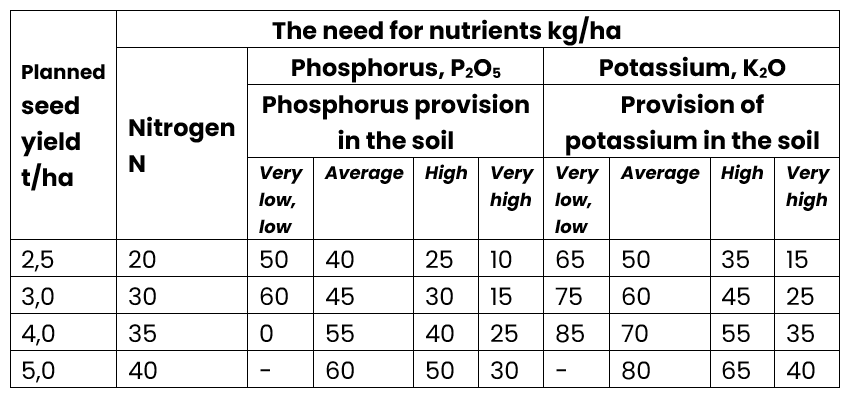
4. Phosphorus and potassium norms for peas and beans are calculated according to the planned harvest and agrochemical properties of the soil.
5. Nutrient requirements for beans and peas:
6. Conditions: Org. substances >1.5%; reaction pH KCl >6.5; Pre-plant: winter and summer cereals, root crops or tubers, corn, rapeseed. 7. Yield without fertilizer: 8. In poorly cultivated soil 1.0 t/ha 9. In well cultivated soil 2.0 t/ha. 10. Notes: Organic manure is used for pre-plant; 11. Nitrogen, phosphorus and potassium mineral fertilizers are incorporated into basic fertilization in spring - before sowing or at the same time; 12. It is expected that the nitrogen requirement will be partly covered by the biological fixation of N. 13. a (up to pHkcl 6.5), the effectiveness of rubber bacteria decreases. During pea germination and at the beginning of growth, in soils poor in organic matter (< 1.5%), the required nitrogen fertilizer is 15-30 kg/ha. For field beans, nitrogen fertilizer (30-40 kg/ha in slurry) can also be incorporated into the soil before sowing. 14. Peas and beans are sensitive to increased concentration of salts, so it is not recommended to incorporate basic fertilizer at the same time as sowing in row fertilizer. 15. Soils with an acidic reaction should be limed before growing peas and beans. The liming rate is determined based on the results of agrochemical soil research, and the choice of liming material depends on the content of calcium and magnesium in the soil. Liming is recommended 1-3 years before sowing peas and beans. If there is or is possible a deficiency of nutrients, it is easier to prevent or prevent it with foliar fertilization. Not only primary nutrients (N, P, K), but also sulfur, boron and molybdenum are important for ensuring high yield and quality of peas and beans. 16. Manifestation of nitrogen deficiency in peas and beans is paler edges of older leaves, later the whole leaf. In the absence of nitrogen, sufficient activity of rubber bacteria is not ensured. If there is a nitrogen deficiency, additional N fertilization can be used, but not more than 30 kg/ha, so as not to suppress the activity of rubber bacteria. 17. Phosphorus deficiency is manifested by a blue-violet shade of the old leaves, thinner plant stems and reduced growth intensity. 18. Potassium deficiency manifests itself in very rapid necrosis on the edges of older leaves, especially in dry and hot weather, because potassium is an important element for water circulation in the plant. As the deficit continues, the older leaves die off rapidly. 19. Sulfur deficiency in peas and beans is observed when lighter marbling appears on the youngest leaves and growth intensity decreases. 20. When there is a lack of manganese, the interveinal plate of the middle leaves of the plants turns pale. Manganese acts as a catalyst in many biochemical reactions, including photosynthesis, as part of chlorophyll. 21. Manifestation of boron deficiency is light interveinal paling. Peas and beans flower but pollinate poorly. If the boron deficiency is pronounced, the top buds die. 22. Manifestation of molybdenum deficiency is deformation of leaves and (or) bleaching of older leaves. Molybdenum is a catalyst in nitrogen metabolism. 23. To prevent early deficiency of sulfur or trace elements, it is necessary to apply foliar fertilizer several times. 24. Peas and beans are considered a sulfur-demanding crop, so application of sulfur-containing fertilizers should be planned. Foreign literature recommends about 5 kg of sulfur removal with one ton of bean crop. 25. All nitrogen, phosphorus and potassium fertilizers intended for peas and beans are incorporated into the soil before sowing the crop.
 हिंदी
 English
 Español
 繁體中文
 Français
 Português
 日本
 عربي