1. Fertile, loose, deeply cultivated loam or sandy loam soil, can also be grown in peaty soil and floodplain;
2. Well-adjusted humidity regime;
3. The reaction of the soil should be neutral or slightly acidic (pHKCl 5.5 - 7);
4. Flat, weed-free (especially perennial) fields, open, wind-protected areas that warm up quickly in spring;
5. Heavy, wet and acidic soil is not suitable.
Soil preparation
1. The best precursors for growing onions are cereals, cauliflower, cabbage, carrots, celery, cabbage, radishes, cucumbers, tomatoes, legumes, pumpkins, spinach and corn;
2. It is not recommended to grow onions after bulbs (onions, garlic, leeks, also bulb flowers), potatoes and grasses;
3. Onions are grown in one place no more than once in 3 years;
4. The intended place should be prepared already in autumn;
5. The soil is peeled first. The first time it is done after harvesting, and again - after weed germination with a ploughshare, spade, chisel-shaped branch and other peelers;
6. After that, the soil is plowed to a depth of 25 - 30 cm. If it is done in spring, then 20 - 25 cm. With autumn plowing, sprouted weeds are destroyed;
7. If there are perennial weeds in the field (creeping spikelet), peeling is repeated after 3 - 5 weeks;
8. In the spring, when the soil dries up, the field is leveled twice. It delays the drying out of the soil and improves the porosity of the topsoil.
9. Using grooved or pine rollers, cultivate the soil (twice), incorporating mineral fertilizer. The second cultivation is carried out shallow -3 - 5 cm deep;
10. In heavier soils, soil slippage is performed at the same time as harrowing;
11. In order to prepare a cleaner field, it can be shallowly watered several times, - this way the germinating weeds are destroyed;
12. If possible, it is best to prepare the soil with a compactor immediately before sowing the onions, as soon as the soil has dried enough, but still retains enough moisture;
13. Create beds or furrows in a field intended for growing onions (if grown from small onions).
Climatic conditions and humidity
1. The main tasks of caring for onion seeds and plantings are loosening the rows to limit weeds, watering, additional fertilization, limiting diseases and pests;
2. Shallow (up to 2 cm) inter-row loosening is performed to limit germinating weeds;
3. Onions are moisture-demanding crops;
4. Sensitivity to lack of water is moderately high;
5. Moisture is needed throughout the vegetation period;
6. An excessive amount of moisture at the end of the growing season delays the ripening of onions and worsens their storage;
7. Increased moisture requirements for onions are necessary at the beginning of seed and small onion germination and growth (5 - 6 weeks after germination);
8. Lack of moisture in the 3-7 leaf stage can significantly reduce the yield of onions;
9. Optimum soil moisture for onions during growth is 75 - 80%, during onion ripening 60 - 70%;
10. Irrigation water doses depend on the type of soil (10 - 20 mm);
11. After each watering, it is recommended to loosen the shallow rows to prevent the formation of a crust and the germination of weeds.
Fertilization
1. Soils with a high content of organic matter are not suitable, so they are incorporated into the pre-plant;
2. The amount of N given by the total amount of applied manure must not exceed 170 kg N/ha;
3. Both sown and planted small onions suffer from a high concentration of salts in the soil, therefore, when incorporating mineral fertilizer into the soil, care must be taken that the onion and fertilizer granules do not come into contact (at least 5 cm between them);
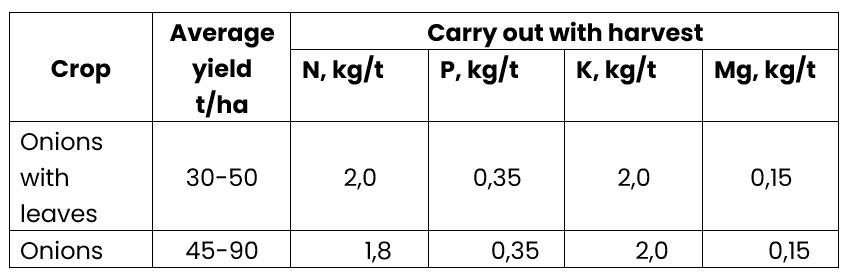
4. Nutrient elements for onions:
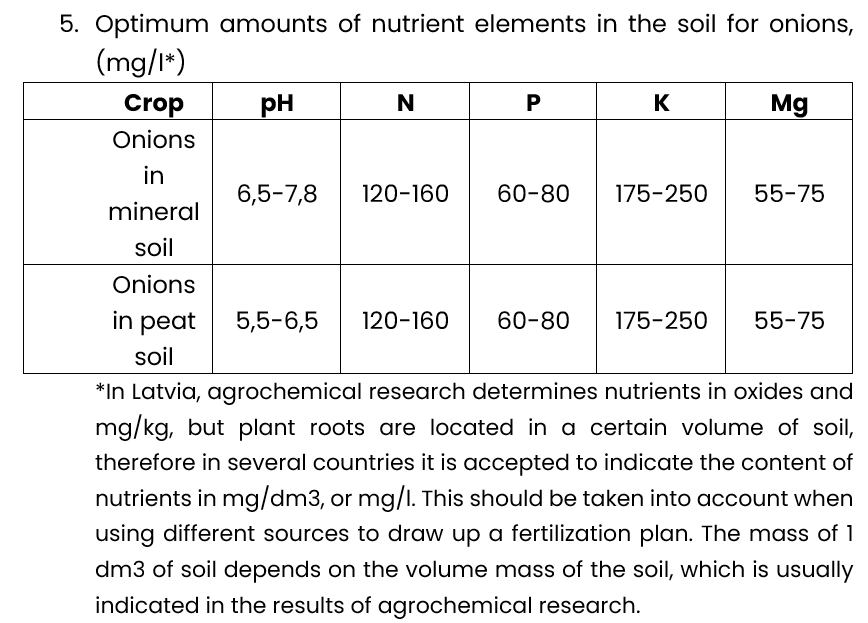
6. Fertilizer doses depend on the results of soil analyses; 7. Approximate fertilizer doses for onions are N (100 kg/ha), P2O5 (80 - 100 kg/ha), K2O (180 - 220 kg/ha); 8. Nitrogen can be incorporated separately. 60% of the nitrogen dose is incorporated before sowing or planting, the remaining 40% - during additional fertilization until mid-June. If the supply of nitrogen in the soil is high, then 30 kg/ha can be incorporated before sowing or planting, and the remaining 50 - 60 kg/ha is given in several additional fertilizations, until the plant has formed 6 - 7 real leaves. The last additional fertilization with nitrogen is carried out by the end of June 9. The increased doses of nitrogen - every 20 kg/ha of N above the fertilization norm prolongs the ripening of onions by one week; 9. During cultivation, several additional fertilizing through the leaves with complex fertilizers is recommended. The first additional fertilization is carried out through the leaves in the 3-4 leaf phase, repeating every two weeks. In the event of a prolonged period of heat and dryness (two weeks or more), additional fertilizing through the leaves with calcium-containing fertilizers is recommended. 10. Regular watering of onions ensures better absorption of nutrients.
 हिंदी
 English
 Español
 繁體中文
 Français
 Português
 日本
 عربي