1. Humus-rich, quickly warming, structural, moderately moist soils are suitable for growing field cucumbers;
2. Nutrient-rich clay loam and light to medium loam soils are better soils;
3. Peat soils with a pH level below 6.0 are also suitable for growing cucumbers;
4. Neutral soil (pH 6.5...7.5) is considered the most favorable for cultivation;
5. For cucumbers, the content of organic matter in the soil is preferably 3 - 4%;
6. Heavy, cold and excessively moist soils, which easily form a soil crust, and sandy soils with low humus content and low moisture retention capacity are not suitable for growing field cucumbers;
7. The structure of the soil is very important for cucumbers - it should be loose, with good air circulation.
Soil preparation
1. It is not recommended to re-grow cucumbers and other cucurbitaceous plants (pumpkins, zucchini) in the same place more often than after four years;
2. Cucumbers use organic fertilizers better than many other vegetables, and therefore the cucumber plantation is created on a field that has received manure in crop rotation;
3. Suitable previous crops are leeks, celery, peas, beans, clover and cereals, unsuitable crops are cabbage and sugar beet;
4. Cucumbers themselves are a good preliminary crop for all other crops;
5. Cucumbers give a harvest after two months - sow, display, begin to bloom, and at the end of the second month there is already a harvest;
6. The suitable frequency of plants for field cucumbers is said to be 2.5 plants per square meter.
Climatic conditions and humidity
1. Cucumbers grow well in evenly moist soil, but must be avoided in places where there is a longer risk of excess moisture in rainy summers;
2. The optimal ground water level is 70-100 cm;
3. Cucumber seedlings are heat demanding, even a short-term temperature drop of 3...5°C causes physiological growth disorders for seedlings;
4. The same can also happen in long-term nighttime temperature drop to 6...12°C, especially if low temperature is accompanied by strong wind;
5. Growth disturbances caused by unfavorable growing conditions significantly affect the subsequent growth and yield;
6. Therefore, in our conditions, it is useful to cover cucumber seedlings in an open field with an agricultural film;
7. The use of agricultural film creates a more favorable microclimate for cucumbers, where soil and air temperatures are on average 1...2.5°C higher, plants are protected from the wind and air humidity is higher;
8. Soil temperature 21...24°C, air temperature 22...30°C is considered optimal for cucumbers;
9. Cultivation of cucumbers in an open field should be started only if the average daily temperature in the air layer above the soil is at least 10...12°C;
10. The place of growth must have a southern slope and be protected from the winds, this helps to prevent the temperature from falling to the dangerous limit;
11. If the soil is compacted after watering or rain, loosen the top layer of the soil carefully without damaging the roots;
12. There are two methods for growing field cucumbers:
13. direct sowing of seeds in the field or growing from seedlings. The most suitable time for direct sowing on the field is late May - early June, when the upper layer of the soil has warmed up to 10...12°C. Seeds planted in too cold soil will not germinate and may even rot. Seeds should be sown 2-3 cm deep, in moist soil, and immediately after sowing, it is recommended to cover the seed with an agricultural film;
14. Cultivation of cucumber seedlings for planting in the field is usually carried out in film greenhouses or greenhouses. Seedlings are planted in the open field after frost in warm and windless, but cloudy weather. Plants are planted up to the cotyledons in the soil, which promotes the formation of lateral roots. Plant with 20-30 cm spacing in the row and 100-160 cm between the rows. After planting, the seedlings must be watered immediately and immediately covered with agricultural film. Seedlings growing under the agricultural film give their first harvest up to two weeks earlier. Parthenocarpo cucumber varieties can be kept under the agricultural film throughout the growing season and even during the entire harvest, but then it is troublesome to remove the agricultural film every time.
Plant and soil fertilization recommendations and conditions
1. In order to obtain a good harvest of cucumbers, abundant and balanced fertilization is necessary;
2. Due to low roots and rapid growth, cucumbers are particularly demanding regarding soil fertility;
3. Cucumbers respond very well to organic fertilizers and therefore, in autumn plowing, if possible, it is necessary to give manure (30-40 t/ha) and/or complex mineral fertilizers, which the plants will use gradually throughout the growing season;
4. The amount of N given by the total amount of incorporated manure must not exceed 170 kg N/ha;
5. When applying manure, it should be taken into account that the soil will be "enriched" with weed seeds and weed control should be planned in time (for example, by mulching beds with film or agronet);
6. According to the legislation, the amount of N given with the total amount of applied manure may not exceed 170 kg N/ha;
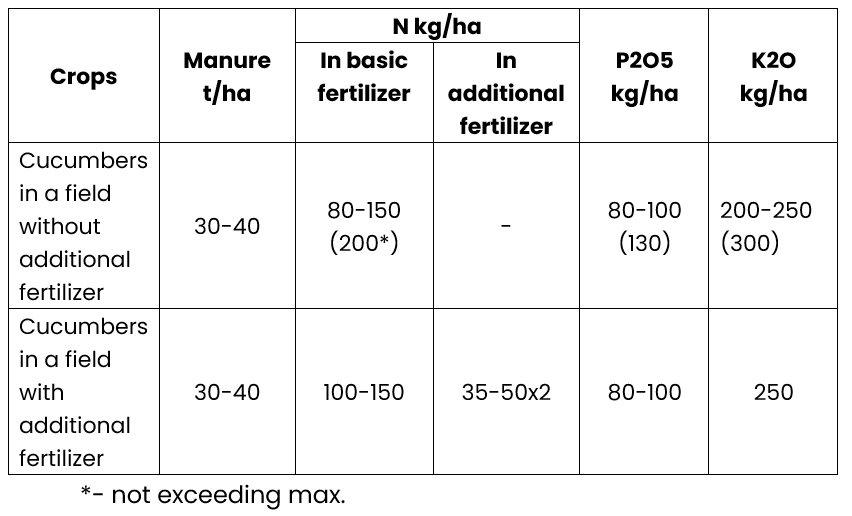
7. Approximate fertilizer rates:
8. When using fertilizer containing calcium cyanamide (Perlka) 10-14 days before sowing or planting seedlings, the number of pests, pathogens and germinating weeds in the top 8-10 cm of the soil is simultaneously limited; 9. About two weeks after planting or, if sown directly in the field, after germination, additional fertilization should be started. The root system of cucumbers is located in the upper layer of the soil, so it is better to fertilize more often, but with smaller doses;
10. In order to provide the plants with all the necessary nutrients, different fertilizers should be used alternately. You should certainly use calcium nitrate, but when buying complex soluble fertilizers, you should familiarize yourself with their composition and choose those that also contain magnesium;
11. With abundant rainfall and poorer soil structure at the place of growth, cucumber plants may experience magnesium deficiency;
12. Deficiencies of manganese, boron, iron, and more rarely, copper, zinc, and molybdenum may also occur from time to time. In the event of such a deficiency, the plants should be sprayed with a 1...2% solution of trace elements;
13. Deniers of mineral fertilizers should understand that plants feed by taking in water with dissolved minerals with their roots;
14. When manure is incorporated, it mineralizes over time, and only then the substances in it become available to plants;
15. Therefore, organic fertilizer should be seen primarily as an improver of soil structure;
16. Cucumbers grow and produce for several months, so additional fertilization should be continued throughout this time;
17. Strong, well-nourished and well-kept plants are more resistant to diseases;
18. If there is not enough fertilizer, increased yellowing of the fruit pods is observed.
 हिंदी
 English
 Español
 繁體中文
 Français
 Português
 日本
 عربي