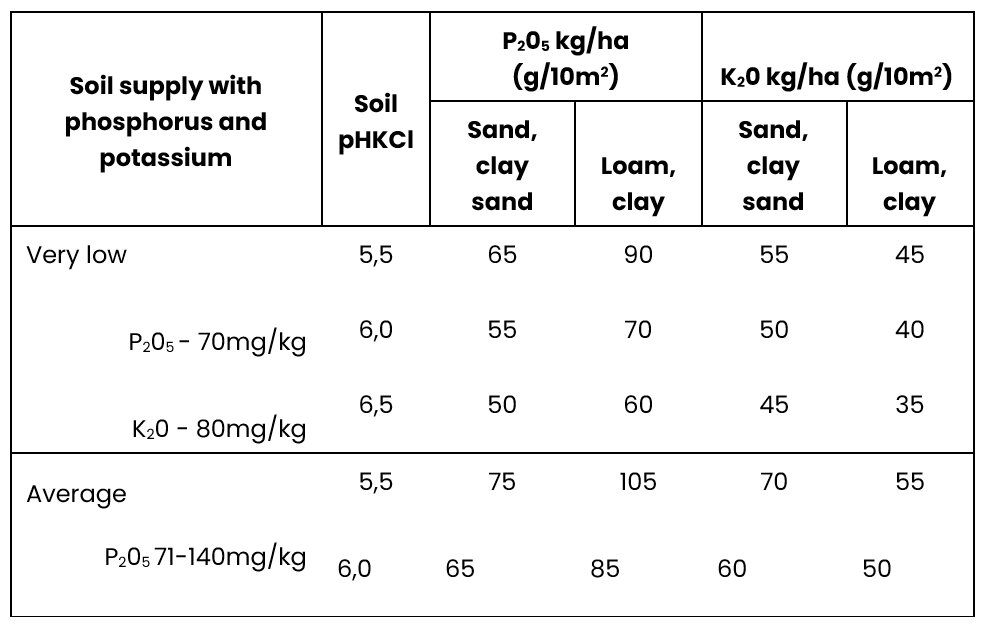
1. Before planting apple trees, taking into account the data of the agrochemical study of the soil, liming of the soil should be carried out, as well as the optimization of the amount of potassium and phosphorus.
2. The level of soil reaction (pH) should be adjusted to the desired level by incorporating the liming material in the autumn of the previous year before planting or before sowing the pre-plant.
3. Depending on the granulometric composition, the optimum soil reaction for cotyledons is pH 5.5 – 7.0.
4. When choosing the material to be limed, the amount of calcium and magnesium in the soil should be taken into account (optimally 5-8: 1);
5. If magnesium is sufficient in the soil, but calcium is lacking, it is recommended to use limestone flour or filter lime;
6. The norms of liming materials depend on many factors, including the granulometric composition of the soil;
7. Different liming materials have different neutralizing power compared to chalk. For example, it is 140% for Saulkalne carbonate lime (respectively, this material will be needed less than chalk), but for Saulkalne dolomite flour and Broceni limestone flour -98%, so these materials will be needed more.
Soil preparation
1. To improve the content of organic matter in the soil, as well as to improve the structure of the soil, it is preferable to sow green manure plants, preferably those that form a deep root system - winter rape sown in the spring, bee clover (on heavy soils, must be grown for two years), lupine (on more acidic soils) , also oil radish, mustard or red clover;
2. Green manure plants should be incorporated at the end of their flowering, when the largest mass has been reached and the stems of the plants have more wood fiber. If you mow too early, the green mass embedded in the soil mineralizes too quickly;
3. If planting in autumn, no later than a month before planting, it is chopped and plowed by mowing or disking.
Climatic conditions and humidity
1. Fruit trees must create a long-lasting strong root system, trunk and branches in the first years of growth;
2. Sufficient nutrients and water must be supplied to new plants for their creation;
3. Their quantity should be balanced, not excessive, to ensure the trees' resistance to adverse environmental factors. In the following years, the trees also use the nutrients stored in the roots, trunk and skeletal branches.
Plant and soil fertilization recommendations and conditions
1. Young trees have a small root system in the first years, so after planting, nitrogen fertilizer should be given only in the area of the root zone of the tree, about 10 g of N (purifying substance) per tree;
2. In the following two years, proceed in the same way, except that the dose must be increased by 5 g every year;
3. Since the tree root system will grow, the area to be sprinkled with fertilizer should also be increased;
4. The amount of nitrogen fertilizer should be such that it provides growth of up to 50 cm for young trees, and 20 - 30 cm for productive trees;
5. In productive plantations with a well-established lawn, trees should be fertilized with nitrogen only enough to cover the yield or branches cut and removed from the garden;
6. In intensive commercial gardens, most of the branches, both in spring and summer, and also in autumn, the fallen leaves and damaged, fallen fruits are crushed when mowing, so both nitrogen and other nutrients return to the circulation;
7. Take out from the garden is only with the crop and very thick branches in the spring, which cannot be crushed when mowing, and partly with fallen leaves blown away by the wind.
8. About 0.6 - 1.1 kg of nitrogen, 0.09 - 0.20 kg of phosphorus (corresponding to 0.2 - 0.5 kg of P2O5) and 1.2 -1.6 kg of potassium (1.4 - 1.9 kg of K2O) are carried out with 1 ton of apples. So, with an apple harvest of 25-50 t, only about 15-30 kg of nitrogen, 29-66 kg of potassium (35-80 kg of K2 O) and 2-11 kg of phosphorus (5-25 kg of P2O5) are taken from ha. At the same time, 30 - 60 kg of nitrogen, 33 - 58 kg of potassium (40 - 70 kg of K2O) can be returned to the soil through organic substances, depending on the amount of grass and cut branches.
9. If this is not taken into account, over the years the trees will grow more and more powerful, and limiting their growth will cause more and more problems. The amount of work and costs in crown formation will increase, and disease resistance and fruit quality will decrease, including during storage. The chances of nitrogen leaching will also increase;
10. The supply of fruit trees with the nutrients they need is indicated not only by the visual assessment, but also by the amount of them in the leaves and fruits, which are determined in the analyzes by relevant laboratories;
11. Doses of macroelements - phosphorus, potassium, calcium and magnesium fertilizers are determined based on soil analyses, and nitrogen - based on leaf analyses;
12. At the end of July, in August, nitrogen should be around 2.2-2.4% dry matter in apple leaves, but less than 60 mg/100 g of fresh fruit in fruits;
13. If the content of this element is less than the optimum, the dose of nitrogen fertilizer should be increased next spring, but if this amount is exceeded, the dose can be reduced;
14. If there is a lack of nitrogen, the leaves are yellow-green, but the fruits are small and, although well colored, dry and tasteless. If there is too much nitrogen in both the leaves and fruits, the leaves of the trees are dark green, the fruits are large with loose pulp, a green base color and a small purple-red top color. In the garden, leaves and fruits suffer more from diseases caused by fungi, winter hardiness of trees is reduced. During storage, fruits are more susceptible to both fungal and physiological diseases;
15. In order to reduce the annual high dose of nitrogen and the excessive growth of shoots caused by the too strong shortening of the branches in the spring, for at least one year, nitrogen fertilization should not be given at all or its doses should be reduced, also reduce the width of the columns of the areas treated with herbicides and change the crown formation techniques. Crown formation in spring should be avoided or reduced, but all crown corrective work should be done in August, cutting out even branches with fruit. An immediate effect cannot be expected, it may take many years until a long-term nitrogen stock is formed, the soil organic matter will decrease;
16. In our conditions, nitrogen fertilizer should be used in spring even before the beginning of vegetation. An exception could be only soils rich in humus with intensive microbiological activity. In trials for apple trees, if the soil was cultivated or hoeed, the highest yields were obtained by applying 60-80 kg/ha (600-800 g/100m²) of nitrogen cleaners (N) annually to the area occupied by the roots. When maintaining the soil in the grass mulch system, it is necessary to slightly increase the dose of skim, but it should be taken into account that high doses of nitrogen worsen fruit storage. In light soils, half of the nitrogen fertilizer is incorporated in early spring, and the other half - at the beginning of flowering;
17. In order to reduce the annual high dose of nitrogen and the excessive growth of shoots caused by the too strong shortening of the branches in the spring, for at least one year, nitrogen fertilization should not be given at all or its doses should be reduced, also reduce the width of the columns of the areas treated with herbicides and change the crown formation techniques. Crown formation in spring should be avoided or reduced, but all crown corrective work should be done in August, cutting out even branches with fruit. An immediate effect cannot be expected, it may take many years until a long-term nitrogen stock is formed, the soil organic matter will decrease;
18. In our conditions, nitrogen fertilizer should be used in spring even before the beginning of vegetation. An exception could be only soils rich in humus with intensive microbiological activity. In trials for apple trees, if the soil was cultivated or hoeed, the highest yields were obtained by applying 60-80 kg/ha (600-800 g/100m²) of nitrogen cleaners (N) annually to the area occupied by the roots. When maintaining the soil in the grass mulch system, it is necessary to slightly increase the dose of skim, but it should be taken into account that high doses of nitrogen worsen fruit storage. In light soils, half of the nitrogen fertilizer is incorporated in early spring, and the other half - at the beginning of flowering;
19. The optimal amount of potassium for plants is on average around 350 mg/kg of soil for apple trees, and up to 400 mg/kg for clay soils. The approximate dose of potassium fertilizer is 100-120 kg/ha (10-12 g/m²;
20. If the mentioned optimum numbers of phosphorus and potassium in the soil have been reached, then the respective fertilizer should not be given until the next soil analyzes show their need;
21. Negative effects on growth, yield, fruit size and coloration will be detected if potassium is less than 80 mg/100 g of fresh mass in fruits and less than 1% in leaf dry matter. If the potassium content in the fruit is higher than 140 mg/100g of fresh mass, browning of the flesh, corky spotting of the bark, and bitter rot damage are possible during storage. An excessive amount of potassium also negatively affects the supply of magnesium to plants;
22. To increase the phosphorus and potassium content in the soil by 10 milligrams per kilogram, the corresponding amount of P205 and K20 above the crop yield and related to the wood.
23. In many poorly fertilized soils, very high doses of appropriate mineral fertilizers may be required to immediately reach the optimum, which may cause soil salinization. To prevent this from happening, according to the data recommended in the literature, the doses of these mineral fertilizers should not exceed the following limit: for ordinary superphosphate - 0.8-1.0 t/ha (8-10 kg/100m2), and for potassium chloride - 0.25 to 0.30 t /ha (2.5-3.0 kg/100m2); 24. Calcium is one of the most important nutrients for fruit trees. It regulates the pH level in the soil, thereby affecting the availability of nutrients, and also improves the soil structure. In plants, it promotes its self-defense abilities against harmful environmental factors. The desired amount of calcium in % of dry matter in apple leaves is 1.0 -1.6. Most (60%) of Ca is transported by leaves, 36% by branches and only 4% by fruits. If the branches are chopped and left in the garden, if the leaves are not also removed, then most of the calcium returns to the soil; 25. Calcium content in fruits ranges from 2.9 – 5.5 mg/100 g of fresh fruit mass. Their amount is affected by various factors. Calcium is more in the fruits of older trees, even if nitrogen fertilizer doses and branch shortening are moderate, if crowns are formed in summer. On the other hand, high doses of nitrogen, strong shortening of the branches in spring reduce the calcium content in the fruits. In order to delay fruit overripeness and reduce physiological damage during storage, the fruit should contain about 4 - 5 mg/100 g of Ca fresh fruit mass. In order to prevent calcium deficiency in apples, as soon as the fruit sets have formed, every 10 - 15 days preparations should be sprayed, which may also contain nitrogen, for example, calcium nitrate, but calcium chloride is recommended before harvesting; 26. The optimal content of exchangeable magnesium for plants is 100-120 mg.kg in loamy soil, 120-140 mg/kg in loamy sand and 140-150 mg/kg soil in sandy loam. If the content of this element in the soil is lower than mentioned, then it should be increased by giving 18-25 kg/ha (grams per 10 m²) of magnesium (Mg) cleaner every year, until the optimum is reached. If the soil needs to be limed, it is advantageous to use dolomite flour, which contains magnesium; 27. Magnesium can also be given through the leaves - magnesium sulfate, Mg nitrate, Mg chelate are suitable for spraying the leaves. It is not recommended to mix magnesium salts with phosphorus compounds, borax, calcium salts, zinc compounds. Do not spray shortly before harvest, as they may promote the development of cork spot; 28. Analysis of the composition of soil microelements is relatively less important, as it is first necessary to optimize the content of macroelements in the soil. If the content of phosphorus, potassium and calcium in the soil exceeds the optimum, the intake of several trace elements is disturbed; 29. The desired content of boron in apple leaves (dry) in July - August is 35 - 45 mg/kg (ppm). Boron deficiency symptoms appear only when its amount is less than 20 mg/kg; 30. The following boron content in the soil is recognized as average: loamy sand 0.20 - 0.35 mg/kg, light sandy loam soil 0.30 - 0.60 mg/kg, heavy sandy loam and clay soil - 0.40 - 0.80 mg/kg; 31. If the apple trees are not sufficiently supplied with boron, the apples may develop "corky spots", similar to the corky spotting of the bark caused by a lack of calcium; 32. Boron's influence on flower fertilization is of the greatest importance in horticulture. Spraying in the fall of the previous year is more effective than spraying in the spring. When spraying trees immediately after harvesting with a 0.2 - 0.3% boric acid solution, boron flows to the vessels, skeletal branches and trunk bark, a little to the roots, but most accumulates directly in the buds. This process can be facilitated if 2.5% urea is added to the boric acid solution; 33. The productivity of apple trees is also promoted by spraying 0.1 - 0.2% boric acid on flowering apple trees during frosts, as well as in years when it is very humid during flowering or there are few flowers; 34. The optimal zinc content in leaves at the end of July, August is 15-25 mg/kg. If the leaves contain less than 10-15 mg/kg of zinc, signs of its deficiency may appear. In particularly severe cases, the flowers fall off early in cool weather or even before frost; 35. The intake of zinc is inhibited by a large concentration of phosphorus and copper. Favorable soil acidity for zinc uptake is pH 6.0-6.5. In acidic to neutral soils, in neutral soils, depending on the degree of zinc deficiency, 5-50 kg of Zn kg/ha should be incorporated in the form of zinc sulfate. This dose is enough for the next 3-5 years. In basic and heavy soils, the same doses should be incorporated after a shorter period of time; 36. Zinc compounds through the leaves work best when the air temperature is 20-22 degrees and the relative air humidity is higher than 50%. Be careful not to burn the leaves.
 हिंदी
 English
 Español
 繁體中文
 Français
 Português
 日本
 عربي