1. Clay-sand or sandy loam soils are most suitable for growing carrots, but some varieties can also be grown in peaty soil.
2. Soils must have a well-adjusted moisture regime and humus content up to 4%;
3. Heavy, wet, stony and acidic soils are not suitable;
4. Soil reaction should be slightly acidic to neutral (pH(KCl) 5.5-7).
Soil preparation
1. Choose flat, weed-free, especially perennial, clean fields for growing carrots, open, sunny, wind-protected places;
2. Light soils are more suitable for growing early varieties, medium heavy soils are better for storage varieties;
3. Carrot roots develop a brighter color in heavier soil;
4. In sandy soil, carrots are threatened by sand storms, covering crops or cutting young plants with grains of sand;
5. The best precursors for growing carrots are cereals, beets, cabbage, spinach, leeks, radishes and corn;
6. If the soil is not infested with nematodes, pre-plants can also be nematode-free potatoes and onions;
7. If organic fertilizer is added to the pre-plant, carrots can also be grown after tomatoes and cucumbers;
8. It is not recommended to grow carrots after cruciferous crops - celery, parsnips and parsley;
9. Carrots grown after potatoes, table and fodder beets, as well as sugar beets can be damaged by purple rot and nematodes, because these crops are host plants of purple rot and nematodes;
10. Carrots are grown in one place no more than once in three years;
11. The carrot root grows in the depth of a well-cultivated field layer, and the amount of harvest depends on the length of the carrot root;
12. Sufficiently loose and evenly worked soil gives the opportunity to grow smoother roots;
13. The place intended for growing carrots should be prepared already in autumn;
14. Peeling of the soil is carried out first: the first time after harvesting the pre-plant and again after the germination of weeds with a ploughshare, spade, chisel-shaped branch and other peelers;
15. After that, the soil is worked well to the full depth of the field row (20-25 cm);
16. With autumn plowing, sprouted weeds are destroyed;
17. If there are perennial weeds (creeping spikelet) in the field, they are destroyed with plant protection products containing glyphosate;
18. In the spring, when the soil dries up, the field is leveled. It delays the drying of the soil and improves the porosity of the top layer of the soil;
19. In heavier soils, soil slippage is performed simultaneously with harrowing;
20. In order to prepare the field as clean as possible for sowing, it can be shallowly watered several times - this destroys the germinating weeds;
21. However, since there is usually a lack of time in spring, one-time soil preparation is more often done just before sowing;
22. It is important that the prepared soil is as uniform and fine-grained as possible - this ensures more even germination and gives the opportunity to grow smoother roots;
23. When cultivating or milling the field, apply suitable mineral fertilizer as necessary;
24. Beds or furrow ridges can be created in a field intended for the cultivation of root crops;
25. Carrots with longer roots are recommended to be grown on the edges of furrows, but it should be taken into account that: a. on furrows, carrots suffer less from diseases, but more from pests; b. harvesting from the ridges of the furrows is faster and a larger amount of the crop can be harvested at the optimal time; c. soil herbicides have a worse effect on furrow edges than on a flat field;
26. Soils with a high content of organic matter are not suitable for growing carrots, so manure is not used for their fertilization - it can be applied to pre-plants 2-3 years before carrot cultivation.
Climatic conditions and humidity
1. Regular watering of carrots ensures better absorption of nutrients. Under the influence of intense rainfall and excessive watering, nutrient elements are washed away.
2. Plant and soil fertilization recommendations and conditions
3. In order to obtain a high-quality harvest, it is recommended to use balanced complex mineral fertilizers, which also contain trace elements;
4. Fertilizer doses are calculated on the basis of nutrient removals and soil agrochemical research analysis data;
5. Each ton of carrots brings out N (1.7 kg), P2O5 (0.35 kg), K2O (4.0 kg), MgO (0.2 kg) from the soil with a yield (40-60 t/ha);
6. Carrot seeds are sensitive to a high concentration of salts, which tend to form from mineral fertilizers in the top layer of the soil, when it dries up quickly, therefore 1/3 part (30-40 kg/ha) of the total nitrogen (N) rate is incorporated before sowing and the rest is distributed 3 – 4 additional fertilizing times;
7. The rate of potassium (K2O) is also divided: 200 kg/ha is incorporated into the basic fertilizer and the rest is given in two supplementary fertilizations together with nitrogen (N);
8. Carrot requirements for phosphorus (P2O5) are moderate. The entire phosphorus rate can be incorporated with basic fertilizer in autumn or spring before sowing;
9. Magnesium (Mg) is very important, which contributes to the health of the leaves, thereby increasing the yield, and reducing the accumulation of heavy metals in the roots;
10. In sandy and acidic soil, it can be incorporated together with dolomite flour;
11. During the growing period, carrots need additional fertilizing several times through the leaves with complex fertilizers containing magnesium and trace elements;
12. The number of times of additional fertilization depends on the length of the vegetation period of the cultivated variety;
13. The lack of boron, copper and manganese is prevented by additional fertilization through the leaves, using special fertilizers in time;
14. Supplemental boron fertilization can help prevent root cracking;
15. The first additional fertilizer is given to the plants a few weeks after germination (5-8 leaves);
16. Depending on the weather and the condition of the crop at the end of July and beginning of August, additional fertilizing may be necessary;
17. Lack of nitrogen worsens the color of carrots;
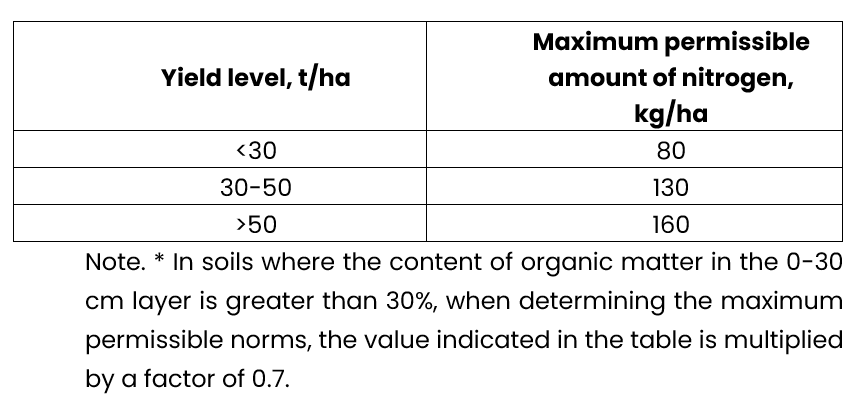
18. The maximum permissible amount of nitrogen* that can be applied to crops in one harvest period, depending on the planned harvest level):
 繁體中文
 English
 हिंदी
 Español
 Français
 Português
 日本
 عربي